
Little Denmark's Delightful Daphne

Dpphne

Daphne

more about Daphne...


Featured Farmdog
Archive

CLICK HERE

Jamie and Lexie

Jamie and Lexie

I spent the previous summer working and saving for a puppy so I was able to use my earnings to buy a Farmdog from Carol, Lexie's breeder. I came up with half the money and my parents decided that I was responsible enough to care for a dog so they paid for the other half and we prepared to bring Lexie home. I kept a countdown of the days it would be until Lexie was old enough. I still remember the day we got to go to Carol's home and see Annika and five cute, little puppies. My brothers and I let them crawl all over us and enjoyed every minute of it.

more about Jamie...


Jera and Daphne

Jara, Daphne and Maddy

Jera has been very dedicated to the training of Daphne. Even before he got Daphne, we talked about dog training. Jera and his Mother read books together about dog training. I.e. they read the book "Before and After Getting Your Puppy" by Ian Dunbar.

more about Jera ...


Kenlyn
Kenlyn and Skoen

A teen making a Difference for Throw Away Pets

Kenlyn's deep love of animals inspired her to look for an opportunity to help discarded and abandon pets. After contacting several humane societies where she hoped she could volunteer and being refused because she is not yet 18 years old, Kenlyn and her mom, Susan, were introduced to the Friends of Silicon Valley Animal Control Authority (SVACA), a support organization for a local animal shelter.

more about Kenlyn...

Fresh Perspectives
Archive

CLICK HERE

Read about all the things Farmdog do.


The Lure of the Lure

Lure Coursing for Sport and Fun

TargetAugust 2009
by Tonya Jensen

details ...


Flyball 101

The Dog's Dog Sport

TargetJune 2009
by Susan Weber

details ...


Herding 101

Sheep Herding Basics

SuzyMay 2009
by Jeri Reinhardt

details ...


Clicker Training 101

Clicker Training Basics

Clicker Training 101April 2009
by Susan Weber

details ...


Agility 101

Agility Basics

Weave polesMarch 2009
by Susan Weber

details ...

Read about all the "How To" Articles.


Dog Show Preparation

September 2009
by Heleene R. Petersen

Learn more...


Takinng Pictures for the DSFCA Calendar

August 2009
by Tonya Jensen and Sally Frankel

Learn how to take Farmdog Evaluation pictures

Learn more...


Takinng Pictures to Show your Dog

June 2009
by Helene R. Pedersen

Learn how to take Farmdog Evaluation pictures

Learn how...


Flying With Dogs in Cargo and in Carry-on

June 2009
by Helene R. Pedersen

Flying with your dog in Cargo and in Carry-on

Learn how...


Traveling with Farmdogs

by Melody Farquhar Chang

Learn how ...


Travel Testamonial

by Michele and Greta

Learn how ...


On-the-Road-Again; Traveling with Dogs

May 2009
by Tonya Jensen

How to Travel in a Car with your Danish/Swedish Farmdog

Learn how ...


How to Make a Shortcut to a Web Site

April 2009
by Susan Weber and Sally Frankel

How to make a Desktop Shortcut

Learn how ...

Medical Papers and Opinions

In this section you will find links to medical articles written about dog breeding, dental care and disease, transmission, prevention and control of canine disease, genetic disorders, pros and cons of early spay and neutering, and canine sports medicine. details...

Canine Medical Organization Links

In this section you will find links to pet health insurance, veterinary research foundations and teaching hospitals, veterinary specialty hospitals, veterinary medical associations and referral services. details...

Dog Supplies and Resources

In this section you will find links to canine sports equipment, fun things to buy for interaction with your dogs, pet supplies, hard to find and unusual items, canine medical supplies, natural nutrition, performance supplements and treats, pet memorials, canine event photographers, training services and information on how to travel with your dogs. details...

Animal Poison Control:
1–800–548–2434
1–888–426–4435

17 Poisonous Plants Video


List of potentially dangerous plants and products:

www.aspca.org

How to Give CPR to your dog:

www.articlealley.com

Disclaimer:  This list of resources is provided as a convenience.  Listing should not be considered as endorsement of products, business, or organizations appearing on this list.


FCIFEDERATION CYNOLOGIQUE INTERNATIONALE (AISBL)

SECRETARIAT GENERAL: 13, Place Albert 1er  B – 6530 Thuin (Belgique)

FCI-Standard n° 356 / 25. 07. 2008 / GB

Danish/Swedish Farmdog (Dansk/Svensk Gårdhund)
Danish/Swedish Farmdog

Translation: Renée Sporre-Willes in collaboration with Jennifer Mulholland.

Origin: Denmark / Sweden

Utilisation: The Danish/Swedish Farmdog has since old times existed at farms. It has been used as watchdog, for killing rats, and as companion dog.

Date of Publication of the Original Valid Standard: 05.07.2008

Classification:

Group 2

Pinscher and Schnauzer, Molossoid breeds – Swiss Mountain and Cattle Dogs.

Section 1.1

Pinscher and Schnauzer type.

Without working test.

Brief Historical Summary: Recognised in Denmark and Sweden in 1987 under the breed name Danish-Swedish farmdog. The breed has been known for a long time on farms in Denmark and Sweden. The farmdog is used as a watchdog, ratter and companion.

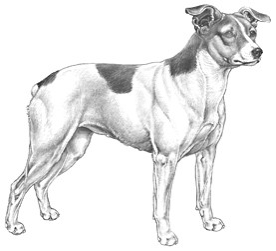
General Appearance: A small, compact and slightly rectangular dog. Known to mature late.

Important Proportions: The body should be slightly rectangular, 9:10. The proportions between depth of body and length of legs should be 1:1.

Behaviour Temperament: Alert, attentive and lively.

Head

Head should be triangular in shape and slightly small in proportion to body.

Cranial Region:

Skull: Rather broad and slightly rounded.
Stop: Well defined.

Facial Region:

Nose: Colour in accordance with colour of patches.

Muzzle: Well developed and gradually narrowing towards the nose but must not give a snippy impression. Muzzle slightly shorter than the skull. Nosebridge straight.

Jaws/teeth: Jaws strong. Scissors bite with even and well developed incisors. Pincer bite tolerated.

Eyes: Medium sized, slightly rounded, neither protruding nor sunken. Attentive and kind expression. Dark eye colour in dogs with black patches. Slightly lighter eye colour permissible in dogs with yellow or liver brown patches.

Ears: Medium sized. Rose or button, in both cases the fold should be just above the skull. Button ears: The tip should lie close to cheeks.

Neck: Of medium length, strong and slightly arched. No throatiness.

Body

Compact with good substance.

Loin:Short, broad and slightly arched.

Croup: Slightly rounded.

Chest: Long, deep and roomy with very well sprung ribs. Forechest well defined.

Underline: Belly only slightly tucked up.

Tail: Not set too high. Naturally long tail or naturally short tail (stumpy or bobbed). Tail should be carried straight, with a slight curve or like a sickle.

Limbs

Forequarters:

General appearance: Front legs straight and parallel. The front is proportionally broader than the width of ribcage.

Shoulders blade: Oblique.

Upper arm: Oblique.

Pastern (Metacarpus): Strong and springy.

Forefeet: Small, oval and not tightly knit.

Hindquarters:

General appearance: Well angulated knee and hock joints. Parallel and well muscled.

Upper Thighs: Fairly broad.

Hind feet: See front feet.

Gait/Movement:

Parallel and free.

Coat

Hair: Short and smooth. Harsh on body.

Colour: White dominating. Patches of different colours, sizes and combinations permissible, (black, tan, brown and different shades of fawn). With or without tan markings. Flecking permissible.

Size

Height at withers:

Males: 34–37 cm
Females: 32–35 cm
Tolerance: +/- 2 cm

Faults

Any departure from the foregoing points should be considered a fault and the seriousness with which the fault should be regarded should be in exact proportion to its degree and its effect the health and welfare of the dog. 

  • Elegant general appearance

  • Narrow in front

  • Low on legs

  • Lack of depth in body

  • Flat or short ribcage

  • Steep croup

  • Prick ears

  • Neck too long

  • Curled tail or tail carried flat over back.

ELIMINATING FAULTS :

  • Aggressive or overly shy.

Any dog showing physical or behavioural abnormalities shall be disqualified.

N. B: Male animals should have two apparently normal testicles fully descended into the scrotum.


Click here to print the Standard