
Flyball 101
I am a Danish/Swedish Farmdog,
and I play Flyball
By Flora's Cool Hand Luke,
Aka, Luke the Dude!
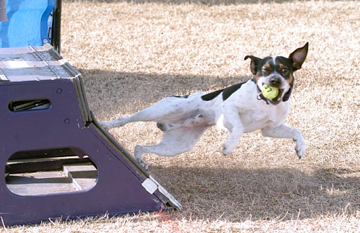 |
| A wink from Flora's Cool Hand Luke Photographer: Pup Art, 2009 |
My sister, Anna, and I play flyball. Anna has been playing three years longer than me. We have trained mom to take us to tournaments all over the United States. We live in California and have a doghouse on wheels for mom to take us to the events. I have been asked to write an article answering the many questions my pals ask me about flyball. --- This is my story and I am sticking to it!
What is flyball?
Ask any high drive dog and they will tell you that flyball is the canine sport where you get to bark your head-off, run, jump, fetch a ball, make like a bullet train back to your owner and bite their hand while pretending it was just an accident. We have the humans trained into thinking that we just miscalculated our grip on the tug because of all the excitement. I love to grab the tug in mid-air and pull mom’s arms out of their sockets!
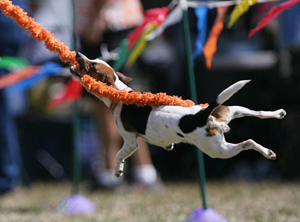 |
| Matilde's Nellie leaping for the tug at the end of a race. - Photographer: Dave Mills |
Ask a human and they will tell you that flyball is the organized canine team sport of relay racing. Stupid humans! What do they know?
Well, flyball is a team sport and it does have some rules. At least that is what my mom tells me. Basically flyball is played with two teams containing four dogs racing next to each other in two lanes of four (4) hurdles spaced ten paws (10 ft) apart. Fifteen paws (15 ft) after the last hurdle there is a spring-loaded box with a ball in it. We pounce on the box and make the ball fly out so we can catch it, then turn and kick-off the box to run back down the lane, jumping the hurdles and cross the start/finish line. The team that finishes first wins. After three (3) to five (5) races mom makes us go back to our jail (she calls it a crate) and rest so we can do it again in about an hour or so. Over a weekend tournament we do this about five (5) times each day.
What kind of equipment do we need for flyball?
I think all we need is a ball and a tug. I could tug until my mom’s arms fall off. If that really did happened I would just shove the tug back at her and try it again. After all she does have a mouth, I am not really sure why she needs arms anyway!
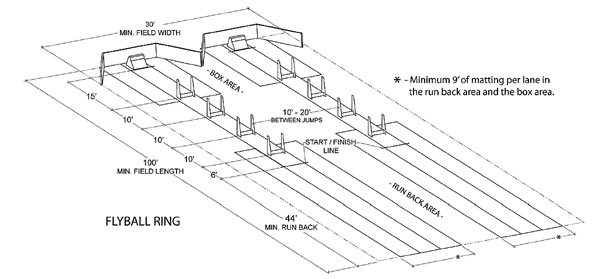 |
| Details about the rules of flyball can be found on the U-FLI™ and NAFA Websites This image was obtained from the official U-FLI™ rule book |
The humans seem to think that we need more equipment to play flyball legitimately. First they say we have to have a tree of lights to start the racing. -- I do not know why they call it a tree; you can not lift your leg on it. If you did you would forfeit the race. -- The tree looks like the ones they use for car racing. It has one blue light at the top, two yellow lights followed by one green and one red light on each side. They tell us that we need in each racing lane four (4) hurdles positioned in a straight line to jump over. The shortest dog on the squad determines the height of the hurdles. Danish/Swedish Farmdogs are often the height dogs. They place the hurdles exactly ten paws (10 ft) apart. It is important for us to always have the same distance between hurdles because we run really fast and our muscles need to know how to time each jump. I think it is called "Muscle memory".
Finally we need a mechanical spring-loaded box placed fifteen paws (15 ft) behind the last hurdle. It holds the balls we need to catch and take back across the start/finish line. We all like different types of balls. It really doesn’t matter what size ball we use, it just has to bounce and roll.The ball has to travel at least 24 inches when triggered from the box. The judge approves the box before racing begins each day. They do not let us participate in the box inspection because we get the ball way before it reaches 24 inches.
| Video 1: Anna doing a run and a box turn at practice. You can see her turn in slow motion to show how she catches the ball and turns off the box. We call that a Swimmer's Turn. - Photographer: Sally H. Frankel |
To make the box work while racing it takes a human to stand behind it and load our favorite ball into a hole. We call that person the box-loader. The guys on my team like to make it hard on the box-loader by forcing him to use a different size and type of ball for each one of us. It is even more fun to make him put the ball in a different hole. Some of us turn right and some turn left. The big dogs like the ball near the edge of the box and the little guys, like me, prefer the ball about six to eight inches in from the edge of the box. We do not need as much room to turn as the big dogs. The front of the box is covered with rubber matting to protect us. The big dogs like to hit the box hard to see if they can knock the box-loader off their feet. Some dogs on our team like to see how much rubber they can rip-off the box around the holes. The challenge is to spit the rubber out while keeping the ball in your mouth and jumping over the hurdles. One of my teammates likes to chew on the ball to see if she can pop it while jumping over the jumps. If she cannot pop it, she spits it out. Just about the only way we can finish a race without penalties is if the ball gets stuck on her tooth so she can not spit it out. She is a silly dog!
What are the rules of flyball?
Well mom tells me that the start dog cannot cross the start/finish line until the lights turn green. If the starter is too early he gets to do it again. My teammates tell me it is really fun to cross the line early because it makes the red light go off, the judge blows a whistle, a human sitting in a chair by the start/finish line waves a flag, and the humans on the team blame it all on the start dog's handler - hee hee! If he does it two times in a row he gets to run an extra time after we all finish racing. The start dog is usually the dog that doesn’t tire easily and likes to race. The really smart ones know how to make it so they get to re-run all the time. They take great pride in making their human handlers look like a jerks.
Video 2: Flyball racing. Two Farmdogs running against eachother. Nellie (start dog) in the left lane and Hannah (3rd dog to run) in the right lane. - Photographer: Sally H. Frankel |
Each dog has to jump the hurdles in consecutive order all the way down to the box. We cannot run around the start/finish line or any of the hurdles. If we do, the people in the chairs start waving their flags and the Judge holds up a finger to indicate that we have a penalty. If your ears are pointing in the right direction you can hear your handler say some bad words. You have to be really good at hearing because the handlers are way back by the judge and he doesn’t allow bad words in the flyball ring. Once we get to the box we have to make sure that we trigger the box to eject the ball. Some dogs try to take it from the box rather than triggering it. When that happens the flag people start waving. I don't think that is a good thing cause the humans do not give us our tugs when the flags are waving. After we catch the ball we have to hold it in our mouth all the way back over the hurdles and across the start/finish line. Then we can spit it out and leap for the tug mom is holding in her hand. This is my favorite part. I especially like it when I get a little fresh meat. -- Don’t tell mom. I really like her and would not want her to think I was a mean dog. It is just so much fun to make her say those bad words when my teeth hit her hand along with the tug.
What is our racing strategy?
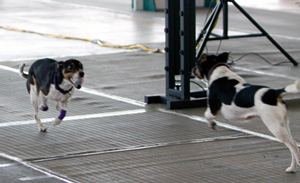 |
| Anna crossing the start/finish line with the ball in her mouth. Luke is just beginning his run. He has about a three foot pass - Photographer: unknown |
The returning dog has to cross the start/finish line before the next dog can run. We like to meet nose to nose running top speed at the line. They call this "passing". To do this the humans hold us way back behind the line, twenty-five to fifty paws (25 to 50 ft) depending upon the speed of the dogs. They let us go just as the dog running before us touches his paws down off the box. We have a human stand at the start/finish line to call the passes. The pass caller holds up fingers to tell the handlers if we have a one, two, or three foot pass. We like to make it zero just to watch her have a heart attack - hee hee. You see, if the next dog crosses the line first the lights go off, the flags start waving, humans start yelling "FLAG", and the pass caller glairs at the handler. If we time it just right to cause all that commotion we get to run again at the end just like the start dog. We pretty much have our humans trained to think that an early pass is their fault - hee hee!
How fast do we go?
The clock starts ticking when the green light goes off and keeps running until the last dog crosses the start/finish line. The course is fifty-one paws (51 ft) from the start/finish line to the box (102 ft total run). The average team runs four dogs in 17 second. Some teams run 14 seconds and some run about 24 seconds. Most Danish/Swedish Farmdogs run the course in about 5 seconds. My brother Maverick is the fastest Danish/Swedish Farmdog; he runs the course in 4.153 seconds.
What do we win?
Well, it seems that the teams that run the fastest and do not make any mistakes get dog toys at the end of the day. Some times the humans get dog tags with ribbons to go around their necks (medals). We earn points towards titles. The humans like to brag about what we earned by wearing title pins. When we get a lot of points they have a party to give us a piece of wood (plaque) with a shiny thing that has our name engraved. Mom hangs ours on the wall. Anna has more than I do. So far she has been the first dog in the U-FLI™ league to get every one of those wood things. Now that she is getting older it is harder for her to stay ahead of the young pups coming up.
How did I get started in flyball?
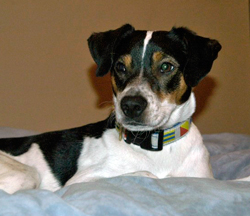 |
| Luke waiting to get back on the computer Photographer: Sally H. Frankel |
Flyball clubs often need more members and frequently offer classes to teach flyball. If you get the chance to go to a flyball tournament talk to the clubs from your area. They all will be happy to explain the rules and tell you about what their club offers. To locate clubs near you just go to the two different flyball league organization's Web sites; they both have club locators.
North American Flyball Association (NAFA) www.flyball.org/flyball_teams.html
United Flyball League International (U-FLI) www.u-fli.com/clublocator.php
Here comes my mom. If she catches me on her computer I am toast. Next time she is not looking I will try to tell you about how I learned flyball and what we do to train and stay in condition for the sport. Tugging is my favorite!
Luke,
Flora’s Cool Hand Luke,
TFX, FDCh-G, NW2
PS: Yes, I really am cool!
